
What to pack for Europe trip
If you are currently sitting with a half packed bag and a rising sense of dread about what to pack for a Europe trip, I want to tell you something I wish someone had told me before my first solo trip. You are almost certainly packing too much. Six solo trips across Europe over 3 years, 14 cities, 47 total days. Carry on only, every single time.
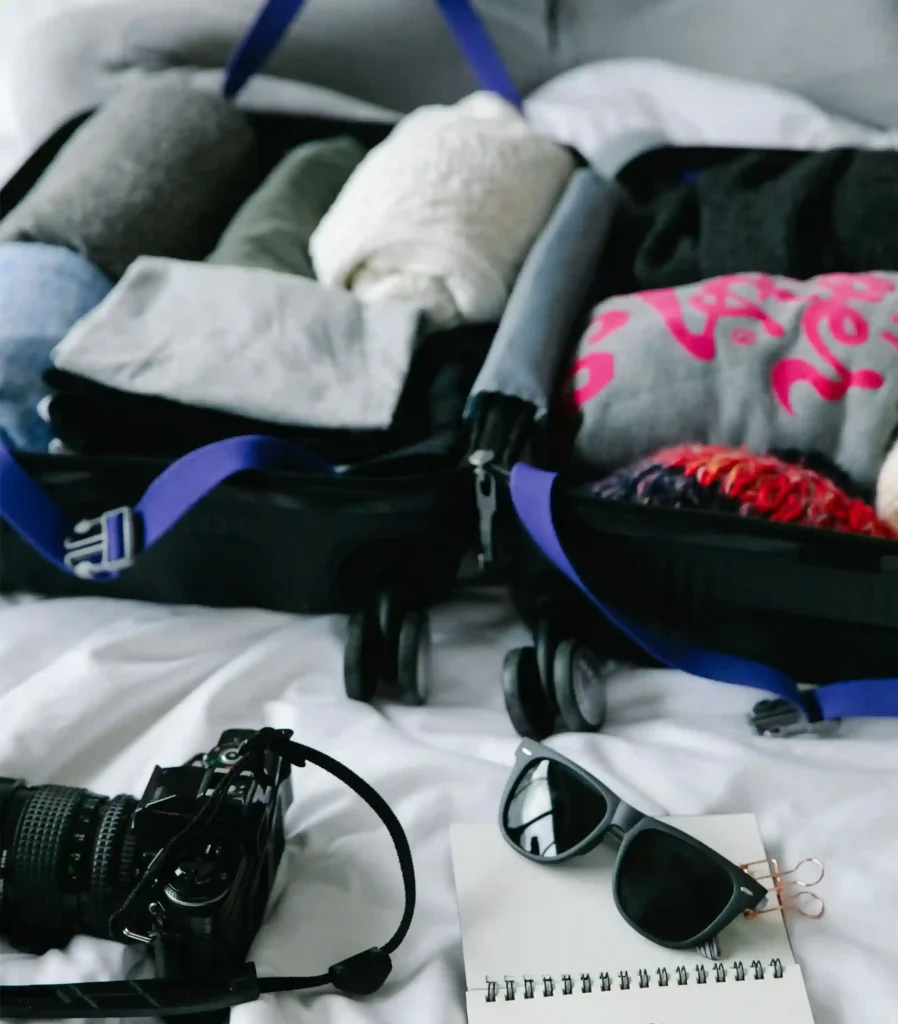
Why packing solo is different from packing with someone
On my first Europe trip, I traveled with a friend. We split the weight across two suitcases and it felt manageable. On my second trip, I went alone to Lisbon and dragged that same suitcase up seven hills in August heat, through three sets of cobblestones, and up a narrow staircase to my Airbnb. I left that suitcase at home permanently after that trip.
Solo travel means you carry everything yourself. Through every metro station with no lift, every overnight train with an overhead rack, every hostel staircase that definitely did not meet fire code. There is nobody to watch your bag while you find the platform, nobody to hold the heavy one while you manage the lighter one. What you pack is what you carry alone.
That reality changes not just what you pack, but how you pack it. Where things go in your bag matters when you are also your own security detail.
Clothing , what actually works for 2 weeks solo
The formula I use: pack for 7 days, wash once midway. Europe has laundromats in every city, Airbnbs with washing machines, and sinks that work fine for a quick overnight rinse of the basics. You genuinely do not need 14 separate outfits for a 14 day trip.
After testing this across Italy, Portugal, Greece, and Hungary, here is the exact clothing list that works:
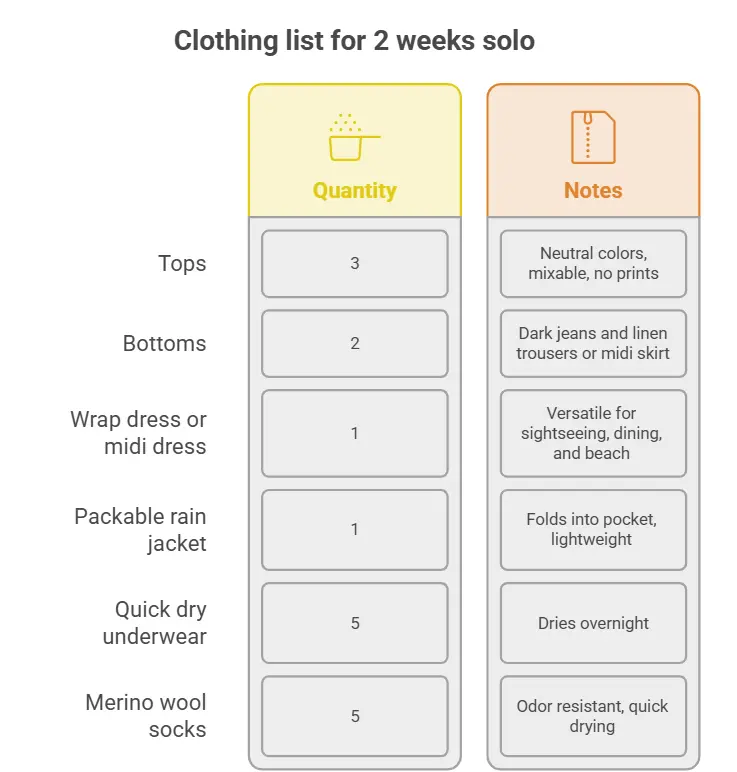
3 tops that mix with everything. I go neutral every time: one white linen top, one grey fitted tee, one slightly dressier blouse that works for a nice restaurant. All three work with both bottoms. None of them are printed, because prints are harder to mix and more memorable in photos if you are posting.
2 bottoms. Dark jeans plus one pair of lightweight linen trousers or a midi skirt. Jeans are heavy but they last 4 or 5 days between washes and they work everywhere from a museum to an evening out.
1 wrap dress or midi dress. This is the highest value item in my bag, because it does triple duty: daytime sightseeing, evening restaurant, and a beach cover up in the right destination.
1 packable rain jacket. The kind that folds into its own pocket and weighs almost nothing. European weather in shoulder season can be three different seasons in one afternoon. I never leave this behind.
5 pairs of quick dry underwear and 5 pairs of merino wool socks. Wash them, hang them overnight, they are dry by morning. Merino wool socks cost more upfront and are worth every penny because they do not smell after repeated wear the way synthetic socks do.
One thing every experienced light traveler mentions that most packing guides skip: go for athletic or technical fabric tops, not cotton. Cotton absorbs sweat, takes forever to dry overnight, and adds weight you feel after day 3. A thin synthetic or linen blend dries in 2 hours over a hostel radiator. Cotton takes all night and still feels damp in the morning.
Packing for Europe by season , what actually changes
The capsule wardrobe above works year round with small adjustments per season. Here is what changes and what does not.
Spring (March to May): the base list works, but add one extra warm layer. European spring is genuinely unpredictable. My packable jacket came out every single day in Prague in April. Two weeks later in Rome I wore a vest. Bring a thin knit or fleece that fits under the rain jacket and you are covered for everything.
Summer (June to August): swap the knit for a hat and add a second pair of sandals if you are doing beach destinations. The dress gets more use in summer. Sunscreen in 100ml containers is worth packing from home because airport prices are painful. Air conditioning in European museums and restaurants runs cold, so keep the packable jacket accessible even in July.
Autumn (September to November): my favourite season to travel and the most forgiving to pack for. The full capsule wardrobe works without modification. Ankle boots replace the smart sandals. If you are going above 55 degrees latitude in November, add a proper knit hat and gloves to the bag.
Winter (December to February): fewer items, heavier items. Swap the packable jacket for a proper waterproof coat and add thermal base layers under everything. Make sure your boots are waterproof and already broken in. Plan a laundry stop every 5 to 6 days rather than 7, because heavier fabrics take longer to dry. Pack 20% less than summer because each piece takes more space.
| Season | Months | Key addition | What to skip | Laundry cadence |
|---|---|---|---|---|
| Spring | March to May | Thin knit or fleece under rain jacket | Heavy boots , ankle boots are enough | Every 7 days |
| Summer | June to August | Hat, extra sandals, 100ml sunscreen | Any warm layers except packable jacket | Every 7 days |
| Autumn | September to November | Ankle boots, knit hat if going north | Sandals unless southern Europe only | Every 7 days |
| Winter | December to February | Waterproof coat, thermals, waterproof boots | Anything that does not layer , pack 20% fewer items | Every 5 to 6 days |
How many clothes to pack for 7 days vs 2 weeks in Europe
The list above is built for a 2 week trip. If you are going for 7 days or 10 days, the items stay the same. The quantities change.
| Trip length | Tops | Bottoms | Shoes | Underwear and socks | Laundry needed |
|---|---|---|---|---|---|
| 5 to 7 days | 3 tops | 2 bottoms | 2 pairs | 5 pairs each | None or once on return |
| 7 to 10 days | 4 tops | 2 bottoms | 3 pairs | 5 pairs each | Once at day 6 or 7 |
| 10 to 14 days | 5 tops | 2 bottoms | 3 pairs | 5 pairs each | Once at day 7 |
| 2 to 3 weeks | 5 tops | 2 bottoms | 3 pairs | 5 pairs each | Every 7 days |
The key insight: bottoms and shoes do not scale with trip length. You do not need more jeans for a 3 week trip than a 1 week trip. You just need a laundry plan. The number of tops scales slightly because tops touch skin more often. Bottoms are fine worn 3 to 4 days between washes.
The complete Europe packing checklist
| Category | Item | Quantity | Solo traveler note |
|---|---|---|---|
| Clothing | Tops (technical or linen fabric) | 3 to 5 depending on trip length | Neutral colours only. Every top works with every bottom |
| Clothing | Bottoms (dark jeans plus one lightweight) | 2 | Jeans last 4 to 5 days between washes |
| Clothing | Wrap dress or midi dress | 1 | Triples as daywear, eveningwear, beach cover up |
| Clothing | Packable rain jacket | 1 | Folds into its own pocket. Non negotiable |
| Clothing | Quick dry underwear | 5 pairs | Wash overnight, dry by morning |
| Clothing | Merino wool socks | 5 pairs | No smell after multiple wears. Worth the cost |
| Clothing | Silk scarf | 1 | Warmth, modesty in religious sites, makeshift pillowcase |
| Clothing | Sleep set | 1 | Thin leggings plus a light top for hostels and overnight trains |
| Shoes | Walking trainers | 1 pair (worn on travel day) | Must be broken in before you leave. Not negotiable |
| Shoes | Sandals or lightweight flats | 1 pair | Also serves as hostel shower shoes |
| Shoes | Smart pair (boots or leather sandals) | 1 pair | For evenings and anywhere with a dress code |
| Tech | Universal travel adapter with USB ports | 1 | Buy before leaving. Airport price is 3 times higher |
| Tech | Power bank (10,000mAh minimum) | 1 | Charge overnight. Lasts a full travel day |
| Tech | Airalo eSIM | 1 | Activate on landing. No roaming charges, no SIM queues |
| Tech | Noise cancelling headphones | 1 | Introvert essential. Recovers energy on long journeys |
| Tech | AirTag in main bag | 1 | Solo safety. Know where your bag is at all times |
| Tech | Phone with offline maps downloaded | 1 | Download Google Maps area before you land. Data runs out |
| Documents | Passport | 1 (on your body) | On your person, not in your bag |
| Documents | Paper copy of passport bio page | 1 (in bag separately) | If bag stolen, body still has original. If original lost, bag has copy |
| Documents | Travel insurance (SafetyWing) | Policy on phone and printed | Medical emergency number saved in phone contacts |
| Documents | Two bank cards from different accounts | 2 (kept separately) | One on body. One in bag. If one is stolen, the other works |
| Documents | Local cash for arrival | Enough for taxi and meal | ATMs can be down. Card readers can fail. Cash covers day one |
| Documents | Flat travel wallet | 1 | Worn under clothes in high risk cities. Barcelona, Rome, Prague |
| Safety | Padlock for hostel lockers | 1 | Most hostels require your own lock. They rarely tell you in advance |
| Safety | Sleep mask and silicone earplugs | 1 of each | Hostels are bright and noisy. 20 grams. Changes everything |
| Toiletries | Prescription medications in original packaging | Full supply plus extra | With copy of prescription. Do not pack these in checked luggage |
| Toiletries | Personal skincare (3 to 4 items maximum) | 100ml containers | Everything else is available at European pharmacies on arrival |
| Toiletries | Minimal first aid kit | 1 small bag | Plasters, paracetamol, rehydration sachets, stomach remedy, antihistamines |
| Toiletries | Laundry detergent sheets | 10 to 15 sheets | Not liquid. Not powder. Sheets. No TSA issue. Dissolve in sink or machine |
| Toiletries | Microfibre travel towel | 1 | 90 grams. Hostels charge for towels. Dries in 30 minutes |
| Bags | Main backpack (40 litre) | 1 | Fits most overhead bins. Hands free. Manageable on cobblestones |
| Bags | Small daypack or tote | 1 | Goes under seat in front. Carries laptop, water, snacks on journey days |
| Bags | Small cross body or waist bag | 1 | Daily carry once you arrive. Keeps hands free in markets and metros |
| Bags | Water bottle (500ml) | 1 | Europe has excellent tap water. Refill everywhere. Saves real money daily |
| Bags | Dry bag or packing cube for dirty laundry | 1 | Keeps dirty clothes separate. Your clean clothes stay clean |
Shoes , the 3 pair rule I swear by
On my first Europe trip I brought 5 pairs of shoes and wore 2 of them. After experimenting across 6 trips, 3 pairs is the answer: one goes on your feet when you travel, two go in the bag.
Walking trainers. Your main shoe. You will walk 15,000 to 20,000 steps a day in most European cities. This shoe needs to be broken in before you leave, comfortable for cobblestones, and not brand new. I wore brand new trainers in Budapest and had blisters by day 2. Do not do this.
Sandals or lightweight flats. For warmer days and indoor wear at hostels. I use Birkenstock Arizona sandals and they have survived Greek islands, Portuguese beaches, and Croatian coastal towns without a complaint from my feet.
One smart pair. Ankle boots for autumn and winter trips, leather sandals for summer. For dinners, walking tours where you want to look like you tried, and anywhere with a dress code.
That is it. Three pairs. The weight and space you save goes toward things that actually matter.
Tech essentials , what I never leave without
Working full time and traveling solo means my tech needs to handle both. Here is what has made every trip genuinely easier, tested across 47 days of solo travel:
Universal travel adapter with USB ports. Europe uses Type C in most countries, Type G in the UK. One universal adapter with 2 USB A ports and 1 USB C handles my phone, laptop, and power bank simultaneously. Buy one before you leave. Airport shops sell them for 3 times the price at 10pm when you need them most.
Power bank, 10,000mAh minimum. On a long travel day, your phone maps, translates, shows your ticket, and contacts your host. It needs to stay alive. I charge my power bank overnight and it gets me through any full travel day without needing a socket.
Airalo eSIM. This changed how I travel more than almost any other single thing. Buy it before you leave your home country, activate it the moment you land, and you have data immediately. No roaming charges, no hunting for a SIM kiosk, no 45 minute queue at the airport. I use Airalo for every Europe trip now and the cost is a fraction of what roaming used to cost me.
Noise cancelling headphones. I need to say something about this that no other packing list will say. As an introvert, noise cancelling headphones on a solo trip are not optional. On overnight trains, in loud hostel common rooms, on long bus journeys through countryside I want to think about, they give me back the energy that crowds take. For people like me, that makes solo travel sustainable. Worth the cost and the space.
AirTag or similar tracker inside your main bag. Solo travel means no one is watching your bag at a cafe while you use the bathroom. An AirTag costs very little and in a worst case situation tells you exactly where your bag went. I added this after a near miss in Barcelona.
Documents and safety , organised differently for solo travel
When something goes wrong on a solo trip, you handle it alone. That means your documents need to be organised for that reality before you leave, not after.
What goes on your body, not in your bag: your passport or a certified photocopy, one bank card, enough local cash for a taxi and a meal, your phone fully charged, and the name and address of your first night’s accommodation written down somewhere physical. Not just saved in your phone.
What goes in a separate compartment of your bag: a full paper photocopy of your passport bio page, your travel insurance policy number and emergency contact, a second bank card from a different account. Keep these separate from your main documents. If your bag is stolen, your body still has everything you need to get somewhere safe.
Travel insurance. I use SafetyWing on most trips. It covers medical emergencies, trip interruption, and delayed luggage. For a working professional traveling solo on a real budget, the monthly subscription model makes more sense than per trip insurance for someone who travels as often as I do. Get it before you leave, not after you land.
A flat travel wallet or neck pouch. In cities with known pickpocketing, specifically Barcelona, Rome, Prague, and the more crowded areas of Paris, I move my passport and backup card to a flat wallet worn under my clothes. Not glamorous, but in 47 days of solo European travel I have never been pickpocketed once.
A padlock for hostel lockers. If you stay in any hostels, the lockers usually require your own lock. Most hostels will not tell you this in advance. A small TSA padlock weighs almost nothing and removes one layer of anxiety from your first night somewhere new.
Sleep mask and earplugs. Hostels are noisy and the lights go on at odd hours. A sleep mask and a pair of silicone earplugs weigh about 20 grams combined and have saved more trips than I can count. This is the advice that appears in every single experienced traveler thread and almost never in travel blog packing lists.
Toiletries , what to bring, what to buy there
Everything that exists in a Boots, dm, or European pharmacy does not need to come from home. Shampoo, conditioner, body wash, sunscreen: buy them on arrival. Most European supermarkets and pharmacies stock international brands and the prices are comparable.
What to bring: your specific prescription medications in their original packaging, ideally with a copy of your prescription translated or at least legible. Any skincare your skin is specific about. I have dry skin and the European formulations of my usual moisturiser are different enough to matter, so I bring my own in a 100ml container.
A minimal first aid kit matters more than most people pack for. Plasters in a range of sizes, paracetamol and ibuprofen, rehydration sachets, something for stomach upsets, antihistamines. These cost very little, weigh almost nothing, and at 2am in an unfamiliar city when you need them, they feel like the most important things in your bag.
The TSA carry on rule: all liquids in containers of 100ml or less, everything in one clear resealable 1 litre bag. Keep it in the top or front pocket of your backpack. You will take it out at every security point, and having it accessible saves you from being that person holding up the queue.
Laundry detergent sheets instead of liquid. This is the tip that appears in every experienced traveler forum and almost no travel blog. Laundry sheets are flat, take up zero space, do not count in your liquids allowance, and dissolve completely in a sink or washing machine. I switched from liquid detergent 3 trips ago and will never go back. A pack of 30 sheets fits in a coin purse.
A microfibre towel. Hostels often charge extra for towels, or the towels are thin and take forever to dry. A microfibre travel towel weighs 90 grams, dries in 30 minutes, and fits in a sandwich bag. Worth bringing even if you mostly stay in hotels, because it doubles as a beach towel and a gym towel on travel days.
Bags , why carry on only is the right answer for solo travel
Checked luggage adds cost, time, and risk on a solo trip. Ryanair and easyJet charge separately for checked bags, sometimes more than the base fare itself. Checked bags get lost at transfer points. And pulling a large suitcase solo through cobblestone streets in Florence at 8pm after a delayed flight is a specific kind of misery I have experienced once and will not repeat.
For carry on only, I use a 40 litre backpack as my main bag. It fits in most overhead bins on European budget airlines, it goes on my back so my hands are free, and it is small enough to sit on my lap on buses and trains when the overhead rack is full.
A smaller daypack or tote goes under the seat in front. This carries my laptop, chargers, water bottle, snacks, and anything I need to access during the journey. On arrival days, the daypack goes on my front and the main backpack goes on my back and I look slightly ridiculous and completely fine.
A small cross body or waist bag for daily use. Once you arrive and leave your main bag at the accommodation, you need something for your essentials: phone, one card, some cash, keys. A small cross body or waist bag that sits flat against your body works better than a full handbag in crowded tourist areas. It is also faster to access when you are navigating metros and markets alone.
A water bottle. This feels obvious but I went without one for two trips and spent a noticeable amount on bottled water every day. A lightweight 500ml bottle that you refill at cafes, restaurants, and hotel lobbies is enough. Europe has some of the best tap water in the world. Use it.
A dry bag or small packing cube for dirty laundry. Keeping dirty clothes separate from clean ones is a small thing that makes a big difference on a long trip. A simple 10 litre dry bag from any outdoor shop works perfectly. Your clean clothes smell like clean clothes. Your bag smells like your bag. Worth it.
What not to pack , the solo traveler edition
A full size hairdryer. Every hotel, hostel, and most Airbnbs in Europe have one. I have checked. Leave yours at home and recover 600 grams of weight for something worth carrying.
More than one physical book. I know. But one book per trip is the honest limit. Everything else goes on your phone or ereader. One book, maximum.
A second pair of jeans. You will wear the same pair every day. The second pair sits in the bag unused. One pair of dark jeans, worn on the travel day, washed midway through the trip.
Heels. I brought wedge heels to my first Lisbon trip. Lisbon is built on seven hills with historic tram tracks running through the streets. I wore the heels for approximately 40 minutes on day 1. Leave heels at home unless your trip is specifically, entirely, only indoor or flat surface events.
Your full skincare routine. A 10 step skincare routine does not travel well in 100ml containers. Edit it down to the 3 or 4 products your skin actually cannot go without and buy the rest there.
Frequently asked questions
What is the 5 4 3 2 1 packing rule for Europe?
The 5 4 3 2 1 packing rule means bringing 5 sets of socks and underwear, 4 tops, 3 bottoms, 2 pairs of shoes, and 1 jacket. It is a workable framework for a 7 day trip. For 2 weeks solo, Madhu recommends the same item count plus a planned laundry stop at day 7. The rule works best as a ceiling, not a target.
What is the most forgotten item when traveling to Europe?
A universal travel adapter is the single most commonly forgotten item for Europe trips. Most of continental Europe uses Type C plugs, but the UK uses Type G. Without an adapter you cannot charge anything on arrival. Buy one with built in USB ports before you leave. Airport shops sell them, but at a significant markup right when you most need them.
What is the 3 3 3 rule for packing?
The 3 3 3 packing rule means bringing 3 tops, 3 bottoms, and 3 pairs of shoes. It works well for shorter trips of 5 to 7 days and is a good starting point for first time solo travelers. For longer trips, the same item count works if you choose quick dry fabrics and plan to do laundry once midway through.
What shoes should I pack for a Europe trip?
Pack exactly 3 pairs: comfortable walking trainers for daily use, sandals or lightweight flats for warmer days and indoor hostels, and one smart pair for evenings out. Never pack shoes that are new and unbroken. Your feet need to already trust them before you walk 15,000 steps a day across Roman cobblestones.
Should I pack a carry on bag or checked luggage for Europe?
Carry on only. Budget European airlines including Ryanair and easyJet charge separately for checked bags, often more than the base fare. A 40 litre backpack fits in most overhead bins across European budget airlines, saves you time on arrival, and eliminates the risk of lost luggage entirely. Every item on this list fits in carry on.
Is solo female travel in Europe safe?
Yes. Europe is consistently rated among the safest regions globally for solo female travel. Most major cities are well lit, well connected by public transport, and genuinely used to independent travelers of all backgrounds. The documents and safety section above covers how to organise your belongings specifically for solo travel, which is different from traveling with a companion.
What to pack for a Europe trip in winter?
For winter travel in Europe, swap the packable rain jacket for a proper waterproof coat and add thermal base layers under your regular clothing. Pack waterproof boots that are already broken in. You pack fewer items than summer overall because each piece is heavier, but the capsule wardrobe approach still applies. Plan laundry every 5 to 6 days rather than 7.
What to pack for 7 days in Europe?
For a 7 day Europe trip, pack 3 tops, 2 bottoms, 2 pairs of shoes, and 5 sets of underwear and socks. You will not need to do laundry if you choose quick dry fabrics. The item list is identical to a 2 week trip. The quantities are just smaller. One packable jacket, one bag, one week of adventure.
What to pack for 9 or 10 days in Europe?
For 9 or 10 days in Europe, pack 4 tops and plan one laundry stop at around day 6. Everything else on this list stays the same. The bag does not get bigger. The shoes do not multiply. One extra top covers the extra days and a laundry stop covers the rest.
The Solo Moment
There is something I did not expect about packing solo. The first time I sat on my bedroom floor with every item laid out, I felt completely alone in a specific way. There was nobody to ask whether I needed the extra jumper, nobody to say “you will be fine.” Just me and a pile of clothes and a flight leaving in the morning.
I almost overpacked out of fear. Three extra items I did not need, because leaving them out felt risky with nobody there to reassure me.
Six trips later, that same process is one of my favourite parts. Sitting with my bag, deciding alone. Every item earns its place or it stays home. That is a quiet clarity I do not find anywhere else.
Packing light is how the trip starts to feel like yours.
What is the one item you always pack for Europe, and the one you always regret bringing? Leave it in the comments. I read every single one.
